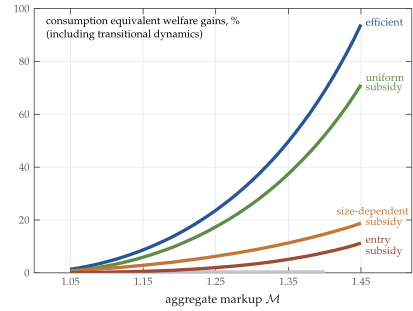
Consumption equivalent welfare gains (including transitional dynamics), from the initial distorted steady state to the new steady state for a range of targets for the aggregate markup \(\mathcal{M}\). For each \(\mathcal{M}\) we recalibrate the Pareto tail \(\xi\), demand elasticity \(\bar{\sigma}\), super-elasticity \(\varepsilon/\bar{\sigma}\) and weight on value-added \(\phi\). The alternative policies are (i): the efficient allocation, where all markups are removed, (ii) a uniform subsidy that eliminates the aggregate markup, (iii) size-dependent subsidies that eliminate misallocation and the entry distortion, and (iv) the uniform entry subsidy that leads to the largest welfare gain. Shaded interval indicates range of \(\mathcal{M}\) implied by the US Census of Manufactures from \(1972\) to \(2012\), as discussed in Appendix B.
In the paper: Figure 3. Welfare Gains from Alternative Policies.