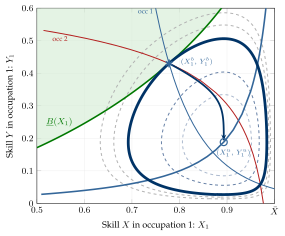
The planner’s indifference curves are level sets of \(U(F_1(X_1,Y_1),F_2(\overline{X}-X_1,\overline{Y}-Y_1))\). The bundled allocation \((X_1^b,Y_1^b)\) is marked with an asterisk where the solid indifference curve is tangent to the boundary \(\underline{B}(X_1)\). The dashed indifference curves are other level sets. The curved arrow from \((X_1^b,Y_1^b)\) to the unconstrained allocation \((X_1^u,Y_1^u)\), marked with an open circle and lying on the contract curve, shows the gradient flow, the path of steepest ascent. The isoquants for each occupation through \((X_1^b,Y_1^b)\) are labeled occ 1 and occ 2; they cross rather than being tangent, reflecting the wedge created by the binding bundling constraint.
In the paper: Figure 4. Geometry of the solution when the bundling constraint binds.